
The Community Strategy Roadmap You Need For 2026!
It's that time of the year and everybody go feel am ‼️

Your 2026 Community Strategy Roadmap: From Audit Insights to Action….
Hiyaaaaa, if you’re new here (welcome! 🎉) and to the oldies, welcome back to The Community Manager Guide — your weekly dose of practical frameworks, stories, and strategies to build profitable and sustainable communities.
The CM Guide Weekly Newsletter
Can you believe we’re already planning for 2025? Like, where did this year go?! 🤯
But honestly? This is the BEST time to be reading this newsletter. Because while everyone’s scrambling in January wondering “what should we do this year,” you’re going to walk into 2026 with a clear, strategic roadmap already mapped out.
Now let’s get into this week’s big one ⬇️
You know that feeling when you finish a really good audit?
You’ve spent hours collecting data, analyzing trends, identifying wins and gaps. You’ve got this beautiful report with charts, insights, recommendations. You’re proud of it.
Then you close the laptop and think: “Okay... now what?”
Because Insights without action are just... that, INSIGHTS!
You can have the most detailed audit in the world. You can know exactly what worked and what didn’t in 2025. You can have a 20-page document full of learnings.
But if you can’t turn those insights into an actionable plan for 2026, you’ve basically just created expensive entertainment.
And I don’t want that for you.
This week, before our masterclass on the 13th, which if you haven’t register for, I don’t know how to help again. I want to bridge that gap. We’re taking everything you learned from your year-end audit (you did run one, right? 👀) and transforming it into a concrete, executable 2026 Community Strategy Roadmap.
Not a vague “let’s do better” plan. A real roadmap with:
Clear goals tied to business outcomes
Quarterly milestones you can actually track
Specific initiatives with timelines
Resource requirements and success metrics
By the end of this newsletter, you’ll have a framework you can use immediately to build your 2026 strategy. And a template to make it even easier.
Ready? Let’s build your roadmap.
Why Most Community Strategies Fail (Before They Even Start)
Let me tell you what usually happens in January.
Community managers come back from the holidays feeling energized. They open a fresh Google Doc titled “2026 Community Strategy” and start typing:
“Goals for 2026:
Increase engagement
Grow the community
Host more events
Launch ambassador program
Improve member experience”
They feel accomplished. They share it with their manager. Maybe it gets discussed in a meeting.
And then... nothing happens.
By March, the doc is buried in Google Drive. The “goals” are forgotten. Everyone’s back to reacting to whatever comes up day-to-day.
Why does this happen?
Because what you created was not a strategy. It was just a wish list.
Strategic planning is vital for organizations to achieve long-term goals, ensure efficiency, and adapt to changing conditions. Studies show 71% of the fastest-growing organizations utilize effective strategic planning processes.
But here’s what differentiate effective plans from wishful thinking:
1. Vague Goals vs. Strategic Objectives
“Increase engagement” isn’t a goal. It’s a direction.
A strategic objective looks like this: “Increase member-to-member engagement from 40% to 60% by Q3 2025, enabling a self-sustaining community that reduces CM workload by 20%.”
See the difference? It’s SPECIFIC. MEASURABLE and TIED TO A BUSINESS OUTCOME (reduced workload).
2. No Connection to Audit Insights
If your 2025 audit showed that events had 80% repeat attendance while discussion threads had 8% engagement, your 2026 strategy should reflect that insight.
Double down on events. Fix or sunset ( meaning stop it) discussion threads.
But most strategies ignore what the data already told them, making the data collected useless in the end.
3. Everything Is a Priority (Which Means Nothing Is)
You can’t do 15 things well in one year. Especially not as a solo community manager or small team.
Strategic planning enables organizations to be proactive rather than reactive, allowing them to anticipate changes and adapt accordingly. Deliberate planning involves setting specific, measurable, achievable, relevant and time-bound objectives.
The best strategies pick 3-5 major initiatives. That’s it. Everything else is maintenance.
4. No Timeline or Accountability
“Launch ambassador program” means nothing without:
When specifically? (Q2 2025)
Who’s responsible? (You + Marketing lead)
How will we measure success? (25 active ambassadors by end of Q2, driving 30% of new member referrals)
5. Disconnected from Business Goals
Your CEO doesn’t care about “community vibes.” They care about:
Retention
Revenue
Cost savings
And Brand reputation.
If your strategy doesn’t explicitly tie to at least one of those, it won’t get resources.
So before we build your roadmap, let’s fix these foundational issues.
Now off to the 2026 Community Strategy Framework (That Actually Works)
Here’s the framework I use with every community I work with. It’s simple, but it works because it forces clarity.
A strategic plan, remember is a roadmap used to prioritize initiatives, resources, goals, and operations toward a clearly defined vision. The process emphasizes visioning, goals, objectives, and the plan process itself.
The Five Components of a Solid Strategy:
1. North Star Vision (Where are we going?)
2. Strategic Objectives (What will we achieve?)
3. Quarterly Initiatives (How will we get there?)
4. Success Metrics (How will we know it’s working?)
5. Resource Plan (What do we need to make this happen?)
Let me break down each one.
Component 1: Your North Star Vision
This is your community’s “why” for 2025. The transformation you’re enabling.
Not “build an engaged community” (too vague).
Try:
“By end of 2026, our community becomes the primary driver of customer retention, with community members showing 50% higher renewal rates than non-members.”
“Transform our community from a support channel into a co-creation engine where members generate 40% of our product feedback and content.”
“Build a self-sustaining peer-to-peer ecosystem where 70% of questions are answered by members, not our team.”
A community vision is the definition of what a community wants to be. The visioning process requires asking questions such as ‘what are the community’s shared values?’ and ‘what is important to the community?’
Your vision should excite you AND tie directly to business value. Never forget this!
Action Step: Write one sentence completing: “By December 2026, our community will...”
Component 2: Strategic Objectives (The “What”)
These are your 3-5 major outcomes for the year.
They should come directly from your audit insights. What did your audit tell you to double down on? What did it tell you to fix?
Strategic goals are three to five year objectives that tie closely to your strategic plan. They’re the specific things you want to achieve with clear success metrics.
Example objectives based on common audit findings:
If your audit showed: Low retention after 90 days → Objective: Increase 90-day retention from 35% to 55% by implementing structured onboarding and 30-day check-in rituals
If your audit showed: High CM dependency (you’re in every conversation) → Objective: Shift to 70% member-to-member engagement by launching peer mentorship and empowering 15 community champions
If your audit showed: Events are your highest ROI initiative → Objective: Scale event attendance by 100% while maintaining 75%+ satisfaction scores through member-led regional meetups
If your audit showed: Community isn’t tied to business outcomes → Objective: Demonstrate $50K+ in value through support ticket deflection, product feedback, and retention lift
Notice how : Each objective is specific, measurable, and directly addresses an insight from your audit.
Action Step: Based on your audit, define 3-5 strategic objectives for 2026.
Let me pause here to say, if you don’t know how to run an actual audit, that’s fine, this month, The CM Guide Monthly Event - The COMMUNE is bringing Martha Essien the audit guru to come show us and even explain further or better how to run an actual audit for your community as a CM, and the first 30 people to join the masterclass and stay till the very end will get her highly recommended audit template valued at $5 for FREE!
Component 3: Quarterly Initiatives (The “How”)
Now we break your annual objectives into quarterly chunks.
Quarterly planning breaks annual planning into smaller parts, meeting every three months to set goals, establish metrics, and review achievements. The most important things to include are outcome goals, upcoming quarter initiatives, a recap of the last quarter, and goals for the coming quarter.
Why quarterly? Because:
It’s manageable (90 days is enough time to see results without losing momentum)
It allows for iteration (if something isn’t working in Q1, you can pivot in Q2)
It creates accountability (quarterly check-ins keep you honest)
Here’s how to structure it:
For each objective, map out quarters:
Example: Objective = Increase 90-day retention from 35% to 55%
Q1 (Jan-Mar): Foundation
Audit current onboarding experience
Design new 72-hour activation sequence
Recruit and train 10 community buddies
Pilot new onboarding with next 50 members
Target: 45% retention for Q1 cohort
Q2 (Apr-Jun): Scale & Refine
Roll out new onboarding to all members
Launch 30-day check-in ritual
Implement buddy matching automation
Gather feedback, iterate on weak points
Target: 50% retention for Q2 cohort
Q3 (Jul-Sep): Optimize
A/B test onboarding variations
Scale buddy program to 25 buddies
Launch “Welcome Ambassador” recognition program
Document playbook for sustainability
Target: 55% retention for Q3 cohort
Q4 (Oct-Dec): Sustain & Report
Full onboarding system running autonomously
Train new buddies as needed
Measure annual retention improvement
Build 2026 retention strategy based on learnings
Target: Maintain 55%+ retention
See how each quarter builds on the previous one? That’s strategic progression.
Quarterly roadmaps help teams focus on product needs at a specific time. Having a quarterly plan helps better align planning with the flow of needs and enables better data-driven strategies.
Action Step: For each of your 3-5 objectives, map out quarterly milestones and initiatives.
Component 4: Success Metrics (The “How We’ll Know”)
Every objective needs clear success criteria.
Use KPIs to define key performance indicators, track metrics, and report results. Update your strategic roadmap every quarter or whenever goals change to keep your plan current.
For each objective, define:
Leading Indicators (predict future success):
Number of new members completing onboarding sequence
Number of buddy matches made
Number of 30-day check-in conversations completed
Lagging Indicators (show results):
90-day retention rate
Member-to-member engagement percentage
NPS score
Business Impact Metrics (tie to company goals):
Cost savings from reduced support tickets
Revenue impact from improved retention
Product insights generated
Action Step: For each objective, list 2-3 leading indicators and 2-3 lagging indicators you’ll track.
Component 5: Resource Plan (The “What We Need”)
This is where most strategies fail. They set ambitious goals without considering resources.
Be realistic about what you need:
Time:
How many hours/week will each initiative require?
What can you stop doing to make room?
Do you need to hire help?
Budget:
Platform costs
Tools for tracking/automation
Event expenses
Ambassador/moderator incentives
People:
Can you do this alone?
Do you need support from Marketing, Product, Support?
Should you recruit volunteer moderators or ambassadors?
The Resources and Investment section helps connect financial and human capital to your roadmap. Document estimated costs, resource type, and budget allocation for each initiative to ensure funding aligns with priorities.
Action Step: For each quarterly initiative, estimate time, budget, and people requirements.
Your 2026 Community Strategy Roadmap Template
Alright, theory is great. But let’s make this practical.
I’ve built you a complete template you can copy and customize for your own community.
Download: 2026 Community Strategy Roadmap Template
How to Actually Use This Roadmap (The Implementation Plan)
Having a roadmap is step one. Executing it is everything.
If strategic planning is developing a road map, implementation is about crafting the driving directions—laying out step-by-step how the team will work towards shared strategic goals. Clear communication, aligned job roles, and well-defined timelines for progress monitoring are crucial.
Here’s how to make sure this doesn’t become another abandoned Google Doc:
1. Schedule Your Quarterly Reviews NOW
Block 2-3 hours at the end of each quarter (March, June, September, December) for your strategic review.
Non-negotiable. Put it on your calendar right now.
2. Create a Weekly Check-In Ritual
Every Monday (or Friday, your choice), spend 15 minutes reviewing:
What got done last week?
What’s the priority this week?
Are we on track for this quarter’s goals?
Establish a rhythm for monitoring performance with weekly team stand-ups focused on action plan progress (15-30 mins), monthly leadership reviews of KPIs and initiative progress, and quarterly formal strategic plan reviews.
3. Share Progress Visibly
Create a simple dashboard (Google Sheets, Notion, whatever) that shows:
Progress toward each quarterly milestone
Current metrics vs. targets
Traffic light status (green/yellow/red) for each initiative
Share it monthly with stakeholders. Transparency = accountability.
4. Build in Flexibility
Flexibility is key in any strategic roadmap. Changes in the business environment are inevitable, and your roadmap should be designed to adapt while keeping sight of long-term strategic objectives.
Your roadmap isn’t set in stone. If something isn’t working in Q2, you can pivot in Q3.
The point isn’t rigid adherence to the plan. It’s intentional decision-making based on evidence.
5. Celebrate Wins Publicly
When you hit a milestone, make noise about it.
Share it in your community. Tell your team. Update your boss.
Recognition fuels momentum.
Common Roadmap Mistakes (And How to Avoid Them)
Let me save you some pain by highlighting where people usually mess this up:
Mistake #1: Too Many Priorities
The trap: “We’re going to improve retention AND grow membership AND launch 5 new programs AND redesign the platform AND...”
The fix: Pick 3-5 objectives max. Everything else is maintenance mode.
Quality over quantity. Always.
Mistake #2: Not Connecting to Business Goals
The trap: Your roadmap is all about “community vibes” and “engagement” without tying to revenue, retention, or cost savings.
The fix: Every objective should complete this sentence: “This will help the business by [specific outcome].”
Mistake #3: No Owner or Timeline
The trap: “Launch ambassador program” with no date, no owner, no accountability.
The fix: Every initiative needs:
A specific owner (ideally one person, not “the team”)
A deadline (not “Q2” but “by May 15”)
Clear deliverables
Mistake #4: Setting It and Forgetting It
The trap: You build the roadmap in December, share it in January, then never look at it again until December.
The fix: Quarterly reviews are mandatory. Monthly check-ins recommended. Weekly awareness essential.
Mistake #5: Not Learning from Failures
The trap: When something doesn’t work, you just move on without understanding why.
The fix: Failed initiatives are learning opportunities. Document what didn’t work and why. Those insights inform future decisions.
Your Week-by-Week Action Plan (Start Now!)
Alright, let’s make this concrete. Here’s exactly what to do over the next 4 weeks:
Week 1: Audit Review & Vision Setting
[ ] Pull out your 2024 audit (if you haven’t done one yet, do a quick 2-hour retrospective)
[ ] Identify your top 3 wins and top 3 gaps
[ ] Write your North Star Vision for 2025
[ ] Draft 3-5 strategic objectives based on audit insights
Time commitment: 3-4 hours
Week 2: Quarterly Planning
For each objective, map out quarterly milestones
Identify specific initiatives for Q1 and Q2 (you can be vaguer about Q3/Q4)
Estimate resource requirements (time, budget, people)
Identify dependencies and risks
Time commitment: 4-5 hours
Week 3: Metrics & Review Cadence
Define success metrics for each objective (leading + lagging)
Set up your tracking system (spreadsheet, dashboard, etc.)
Schedule quarterly review sessions for 2026
Create your weekly check-in ritual
Time commitment: 2-3 hours
Week 4: Finalize & Communicate
Polish your roadmap document
Get feedback from a peer or mentor
Present to your manager/stakeholders for buy-in
Share relevant parts with your community
Block time for Q1 execution
Time commitment: 3-4 hours
Total time investment: 12-16 hours spread over 4 weeks.
That’s it. 12-16 hours to create a strategic roadmap that will guide your entire 2026.
Worth it? I think so.
The Roadmap That Changed Everything
Let me close with a quick story.
Last year, a friend of mine, Lola a community manager at an edtech startup used this exact framework. Audit insights → Strategic objectives → Quarterly roadmap.
Our 2025 strategy had three core objectives:
Increase course completion rate from 35% to 60% through peer accountability groups
Launch a mentor matching program connecting 50 students with alumni
Demonstrate $30K in value through support deflection and retention improvement
By December 2024, here’s what happened:
Course completion hit 58% (just shy of 60%, but a massive improvement)
65 students matched with mentors (exceeded goal!)
Demonstrated $42K in measurable value (way beyond target)
But here’s the best part:
In her year-end review, her CEO acknowledged she had transformed from a community manager into a strategic partner. Your roadmap showed us exactly how community drives business outcomes. We’re doubling your budget for 2025.”
That’s the power of a solid roadmap.
It doesn’t just organize your work. It positions you as a strategic leader.
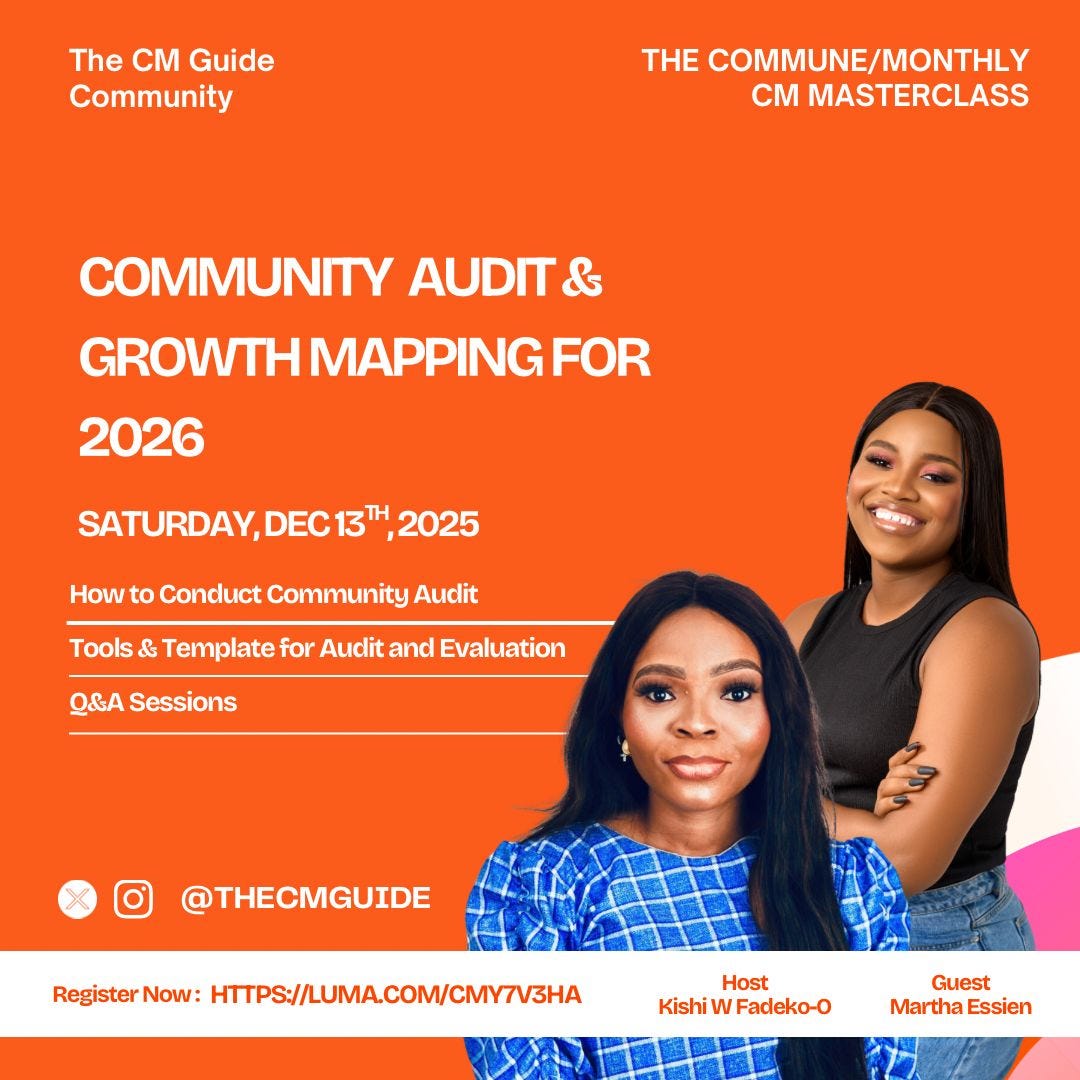
The CM Guide Masterclass is happening on the 13th of December, and you don’t want to miss it.
So click this link to register and get the template and detailed walkthrough of how to apply what you’ve read today.
Your 2026 Starts Now
2026 is going to be your year. I can feel it.
Not because of luck. Not because things will magically get easier.
But because you’re going to walk into January with clarity, strategy, and a roadmap that turns insights into action.
While other CMs are scrambling to figure out priorities, you’ll already be executing quarter one.
While others are justifying their existence with vague “engagement metrics,” you’ll be presenting business impact tied directly to company goals.
While others are reacting to whatever comes up, you’ll be proactively building toward a North Star vision.
That’s what strategic community management looks like.
So here’s what I want you to do this week:
Step 1: Download the template (reply “ROADMAP” and I’ll send it)
Step 2: Block 3 hours this week to start filling it out
Step 3: Schedule your 4 weekly planning sessions
That’s it. Just start.
Because the difference between community managers who thrive and those who burn out isn’t talent.
It’s strategy. And now you have the framework to build yours.
Let’s make 2026 incredible.
ICYMI: The CM Guide WhatsApp community is now 106+ community managers strong, sharing jobs, and lessons you won’t find on LinkedIn or Google.
With you in the journey of chasing members for engagement and convincing people that community management is not small work, see you next week.
Founder, The CM Guide
P.S. — Seriously, reply “ROADMAP” and I’ll send you the full template bundle including:
2026 Strategy Roadmap Template (Google Doc + Notion versions)
Quarterly Review Template
Weekly Check-In Template
Stakeholder Presentation Deck Template
Let’s build this together.
We are now on socials too so kindly follow us and share with your enemies and friends hahahaa.
What’s coming:
Next week: Your Q1 2025 Execution Plan (The first 90 days that set the tone for the year)
Dec 27: Year-end special: The 10 biggest community lessons from 2025
You’re receiving this because you’re part of the CM Guide community.
ROADMAP